





- Tuo AI

- Live

- My Account
- Shopping Cart
- Inquiry Basket
- Contact Us
- Back to Top
Color Coated Steel System > Production Equipment > roof sheet making machine
You can log in to view more discounted prices.Login Now
Shipping fee and delivery date to be negotiated. Chat with supplier now for more details.






The ZTRFM AG & R Panel Roof Roll Forming Machine is a fully automatic production line developed for manufacturing trapezoidal metal roofing and wall panels commonly used in the North American construction market. It is suitable for AG Panel, R Panel and similar exposed-fastener roofing profiles used for agricultural buildings, warehouses, workshops, steel structure buildings, commercial facilities and residential roofing projects.
The line integrates material feeding, guiding, continuous roll forming, automatic length measuring, hydraulic cutting and finished panel receiving. After production length and quantity are entered through the PLC control system, the machine can complete continuous production automatically with minimal operator intervention.

AG Panel and R Panel are widely used metal roofing profiles because of their simple installation, good structural rigidity and broad application range.
A typical AG Panel uses five main ribs across a 36-inch coverage width, while R Panel commonly uses four main ribs across a 36-inch coverage width. The exact profile dimensions can be manufactured according to the customer's drawing, sample or local building standard.
For a typical configuration, the machine processes approximately 43-inch / 1092 mm wide coil material. The roller design, feeding width and finished coverage width are confirmed according to the final profile drawing before production.
The machine is suitable for processing different coated metal coils, including:
PPGI pre-painted galvanized steel
PPGL pre-painted Galvalume steel
GI galvanized steel
Galvalume / Aluzinc steel
Color-coated steel
Suitable aluminum roofing material
A common processing range is approximately 24–26 Gauge, around 0.4–0.6 mm. Different material thicknesses can be supported by adjusting the roller design, shaft strength, motor power and forming structure.
Before manufacturing the machine, we recommend confirming the steel thickness, yield strength, coating and actual coil width to obtain the correct production solution.
The standard production process is:
Uncoiling → Feeding → Guiding → Roll Forming → Length Measuring → Hydraulic Cutting → Finished Panel Receiving
The steel coil is placed on the decoiler and guided into the main forming machine. It then passes through multiple precision roller stations where the flat sheet is gradually shaped into the required AG or R Panel profile.
After forming, an encoder measures the sheet length. When the preset length is reached, the PLC sends a cutting signal and the hydraulic cutting system automatically cuts the panel.
This continuous process helps improve production efficiency while maintaining consistent sheet dimensions.

The main machine can use a 350 mm H-beam base combined with welded steel support plates. The rigid frame provides stable support for the forming rollers, shafts and transmission components.
A strong frame helps reduce vibration during continuous production and keeps the roller stations properly aligned. This is particularly important for long roofing panels because small alignment errors may affect panel straightness and side overlap.
The machine structure can also be strengthened according to material thickness and required production speed.
A standard AG Panel configuration can use approximately 18 forming stations. Each roller station gradually changes the steel sheet until the final trapezoidal profile is completed.
The progressive roll forming method distributes deformation across multiple stages instead of forcing the sheet into its final shape in one step. This helps reduce excessive stress, surface waves and unwanted deformation.
For customized R Panel or other trapezoidal profiles, the number of roller stations is determined according to profile geometry and material requirements.
The complete roller design is calculated according to the customer's confirmed drawing.

The forming rollers are normally manufactured from high-grade 45# forged steel and precision machined according to the roofing profile.
The roller surface can receive hard chrome plating treatment to increase surface hardness, improve wear resistance and reduce corrosion.
A smooth roller surface is especially important when processing pre-painted roofing coils because it helps reduce friction and unnecessary marks on the painted surface.
Rollers are accurately positioned on the shafts to maintain consistent profile dimensions during continuous production.
A typical machine uses approximately Φ80 mm solid steel forming shafts.
The shafts are manufactured from high-grade steel and heat treated to improve mechanical strength. The solid shaft design provides stable support for the rollers during the forming process.
The final shaft diameter can be increased for thicker materials, deeper roofing profiles or higher-speed production lines.
The standard machine can use gear and double-chain transmission.
The double-chain system transfers power between forming stations and provides stable driving force for continuous production. It is a practical transmission method commonly used for roofing sheet roll forming machines because of its reliable structure and convenient maintenance.
For customers requiring higher production speeds, gearbox transmission can also be provided as an optional configuration.

The feeding section guides the coil into the first forming station in the correct position.
Adjustable guiding devices are installed on both sides so operators can align the sheet before production. Proper feeding alignment helps maintain uniform rib position, effective width and overlap dimensions.
The guiding width can be adjusted according to the raw material and confirmed roofing profile.
After the profile has been completely formed, the finished roofing panel enters the cutting section.
The standard line uses hydraulic post cutting. The cutting blade is designed according to the shape of the finished AG or R Panel profile.
High-strength cutting blade material such as Cr12MoV can be used and heat treated to improve hardness and service life.
The cutting system works together with the encoder and PLC. Operators only need to enter the required length and quantity before production, and the machine automatically measures and cuts each panel.
The complete production line is controlled by PLC.
Through the touch screen, operators can set:
Finished panel length
Production quantity
Production batch
Basic operating parameters
Once the production order is entered, the system coordinates the main motor, encoder and hydraulic cutting system automatically.
The control panel can use internationally recognized electrical components. Operating language can also be customized according to customer requirements.
Raw Material: PPGI / PPGL / GI / coated steel
Typical Thickness: 24–26 Gauge / approximately 0.4–0.6 mm
Typical Coil Width: approximately 43 inch / 1092 mm
Forming Stations: approximately 18 rows
Shaft Diameter: approximately Φ80 mm solid shaft
Shaft Material: high-grade steel with heat treatment
Roller Material: 45# forged steel with hard chrome plating
Machine Frame: 350 mm H-beam structure
Transmission: gear and double-chain transmission
Forming Speed: approximately 15–20 m/min
Main Motor: approximately 7.5 kW
Hydraulic Power: approximately 5.5 kW
Cutting Method: hydraulic post cutting
Cutting Blade: Cr12MoV or equivalent
Control System: PLC + touch screen
Voltage: 380V / 50Hz / 3 Phase or customized
Actual parameters are finalized according to the customer's roofing profile, material thickness and production requirements.
The machine can be supplied with a manual decoiler for standard production.
For factories requiring easier coil loading and higher automation, optional equipment includes:
Hydraulic decoiler
Hydraulic expansion system
Coil loading trolley
Motorized decoiler
Automatic feeding system
The loading capacity can be selected according to the customer's coil weight and daily production requirements.
AG and R Panels produced by this machine can be widely used for:
Agricultural buildings
Barns and farm buildings
Industrial workshops
Warehouses
Steel structure buildings
Commercial buildings
Logistics facilities
Garages
Residential roofing
Exterior wall cladding
The trapezoidal rib structure increases the rigidity of thin steel sheet and provides efficient drainage for roofing applications.
Different panel lengths, colors and coatings can be produced from different raw material coils according to project requirements.
ZTRFM machines are not limited to one standard AG or R Panel drawing.
Customers can send their own profile drawings showing complete dimensions, and the machine can be customized accordingly.
Customization options include:
Profile dimensions
Feeding width
Material thickness
Roller stations
Shaft diameter
Machine speed
Transmission method
Decoiler type
Cutting system
PLC brand
Electrical components
Automatic stacker
Voltage and frequency
Control language
For customers producing several roofing profiles, double-layer or multiple-profile solutions can also be evaluated according to the required products.

The standard forming speed is approximately 15–20 m/min.
For manufacturers requiring higher capacity, the production line can be upgraded with gearbox transmission, servo tracking cutting and other high-speed components.
The appropriate speed configuration should be selected according to daily production volume, material thickness and investment budget rather than simply increasing motor power.
Before delivery, the complete machine can be assembled and tested in the factory.
The inspection process normally covers:
Machine frame and roller alignment
Feeding system
Transmission system
Roll forming performance
Hydraulic cutting
PLC operation
Encoder measurement
Finished profile dimensions
Cutting length
Electrical system
Steel coils are used for trial production to check whether the finished panel matches the confirmed drawing.
Customers can also provide their own raw material for testing when necessary.
The machine is designed for straightforward daily operation. After loading the coil and adjusting the material guide, the operator mainly controls production through the PLC touch screen.
Regular maintenance includes checking chain tension, lubrication, hydraulic oil, electrical connections and roller cleanliness.
Keeping the forming rollers clean is especially important when processing painted steel because metal particles or dirt on the roller surface may affect the appearance of the finished roofing panel.
ZTRFM provides technical support for installation, commissioning, machine adjustment and daily operation.
Support can include operating manuals, electrical diagrams, remote video assistance, troubleshooting guidance and spare parts support.
Engineer installation and commissioning services can also be arranged according to project requirements.
For an accurate quotation, please provide your AG Panel or R Panel profile drawing, raw material type, material thickness, coil width, required production speed, voltage and desired automation level. Our engineers can then prepare a suitable roll forming solution based on your actual production requirements.

Roof Drip Edge Roll Forming Machine for Galvanized Sheet Tile Making Easy to
$***
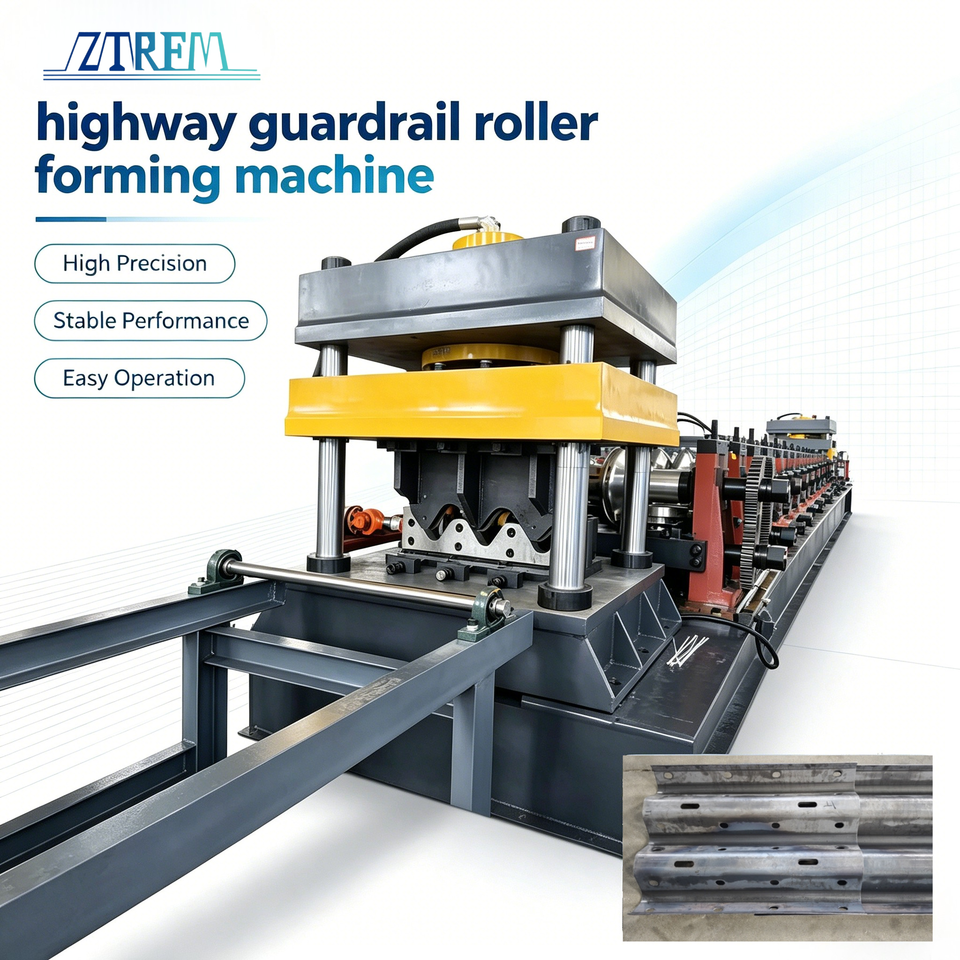
High Speed Highway Guardrail Roll Forming Machine for W Beam Production
$***

Automatic Metal Cable Tray Production Line with 400T Punching Station
$***

Fully Automatic CZ Purlin Roll Forming Machine for Steel Structure Buildings
$***

Gutter Roll Forming Machine Automatic Rain Gutter Production Line Box
$***

High Speed Fully Automatic Glazed Tile Roll Forming Machine Color Steel
$***

Solar Mounting Bracket Roll Forming Machine High Precision PV Support Profile
$***

Automatic C & U Purlin Roll Forming Machine | Dual Profile Steel Frame Line
$***

High Speed Roof Tile Roll Forming Machine Automatic Metal Roofing
$***

LGSF Light Steel Frame Villa Roll Forming Machine Prefab Steel Frame
$***