





- Tuo AI

- Live

- My Account
- Shopping Cart
- Inquiry Basket
- Contact Us
- Back to Top


You can log in to view more discounted prices.Login Now
Shipping fee and delivery date to be negotiated. Chat with supplier now for more details.






The Fully Automatic Anchor Rod Roll Forming Machine is designed for manufacturers that produce steel anchor rods, friction rock bolts, and pipe-seam anchor products for mining, tunnel construction, and ground-support applications. The machine continuously processes steel strip coils into tubular anchor rod profiles through feeding, roll forming, longitudinal seam welding, straightening, sizing, notching, and cutting.
Unlike a conventional production setup that requires several independent machines and frequent manual handling, this Anchor Rod Roll Forming Machine integrates the main production processes into one continuous line. The Delta PLC control system coordinates forming and cutting operations, while the operator can set production parameters through the human-machine interface. As a result, the production line can maintain consistent dimensions and reduce repetitive manual work.
The standard machine uses a 3-ton manual decoiler, while manufacturers can request hydraulic or other customized decoiling configurations according to their material-handling requirements. The machine supports steel strip with a thickness of 2.4–3.2 mm and provides a forming speed of up to 20 m/min, depending on the anchor rod profile, material, and production configuration.
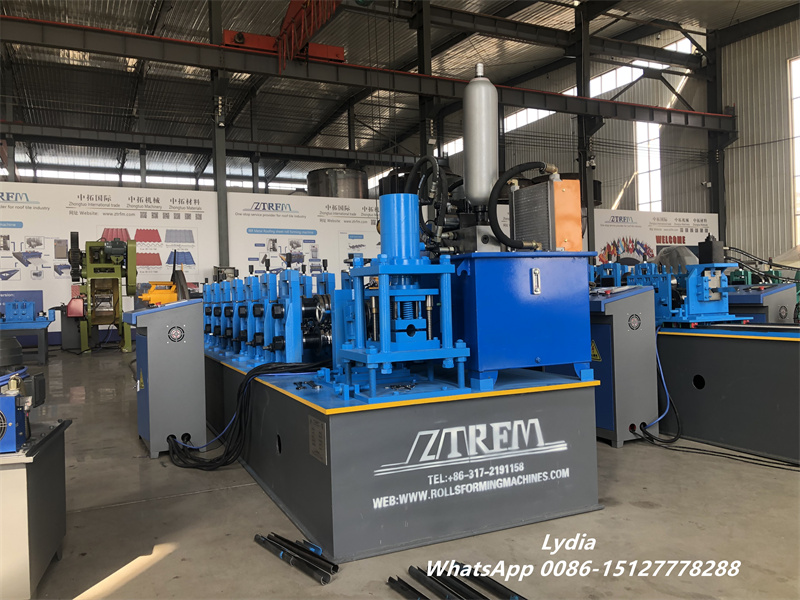
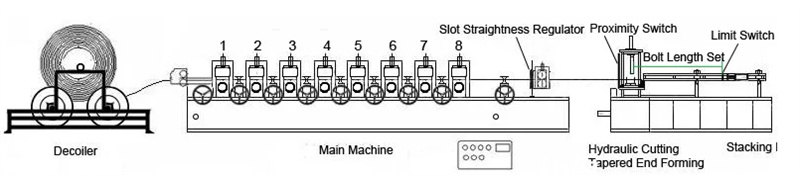
The production line starts with the decoiler, which steadily releases the steel strip into the feeding section. Guiding and feeding rollers then align the strip before it enters the forming unit. The forming section uses multiple precision rollers to gradually bend the flat strip into a tubular profile rather than forcing the material into its final shape in a single pass.
The standard forming section includes 7 roller stations, a 70 mm shaft, Cr12 forming rollers with quench treatment, and gearbox transmission. This multi-pass forming method helps control the profile throughout the process and supports stable production during continuous operation.
After the steel strip reaches the required tubular shape, the longitudinal seam welding system joins the edges. The production line then moves the welded anchor rod through the sizing and straightening section. These processes help control the finished outer diameter, roundness, and straightness before the machine cuts the product to the specified length.
For customers who require additional end processing, the line can incorporate a shrinking machine. The end-reducing process prepares the anchor rod for subsequent thread rolling and helps accommodate components such as trays and nuts.
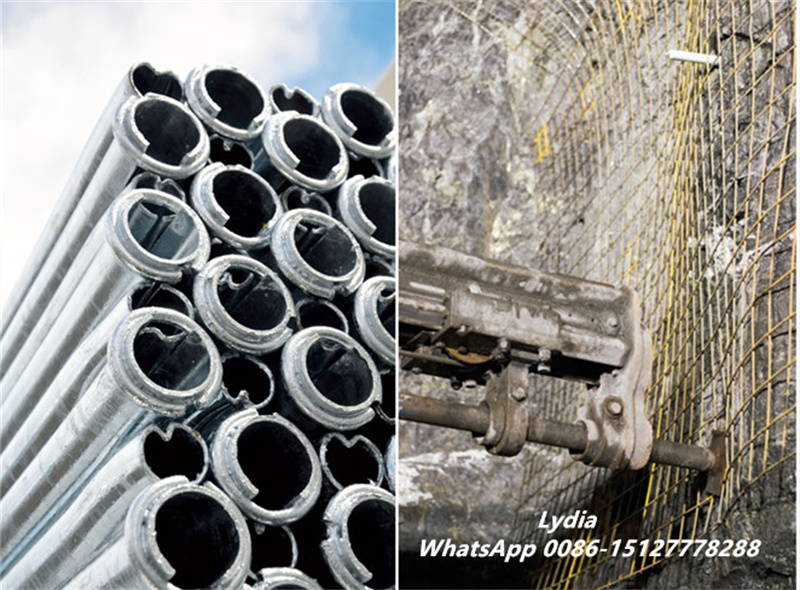
The Anchor Rod Roll Forming Machine can support production for several underground engineering applications. In coal mining, manufacturers can use suitable pipe-seam anchor rods for roof and sidewall reinforcement in underground roadways. The friction-based anchoring structure helps transfer support forces to the surrounding rock after installation.
Metal mines often face different geological conditions, so manufacturers may require reliable friction rock bolts and Split Set anchor rods for roof support and surrounding-rock reinforcement. By producing consistent tubular profiles, the machine helps anchor rod manufacturers maintain stable product dimensions for downstream installation.
Tunnel construction also requires effective ground-support products after excavation. Depending on the final anchor design and downstream equipment, suitable anchor rod products can serve railway and highway tunnel support applications. For specialized products such as hollow grouting anchors, manufacturers should configure the corresponding forming and downstream processing equipment according to the required profile.
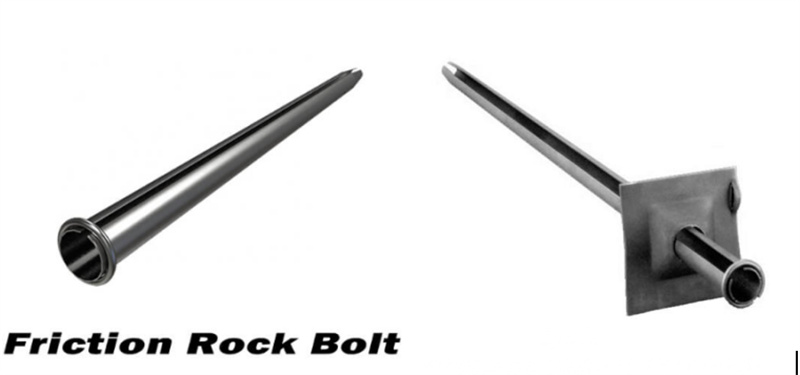
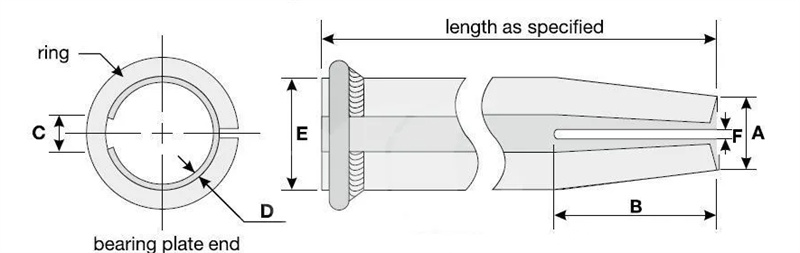
Therefore, the machine can serve different production requirements rather than being limited to a single anchor rod application.
The machine combines mechanical forming equipment, welding, hydraulic cutting, and electrical control into an integrated production line. Each section performs a specific function, allowing the line to maintain a continuous material flow from steel coil to finished anchor rod.
The main configuration includes a 3-ton manual decoiler, feeding rollers, guiding rollers, 7 forming roller stations, straightening equipment, welding equipment, hydraulic cutting and notching equipment, receiving tables, PLC electrical control, hydraulic station, and optional end-shrinking equipment.
| Item | Standard Specification |
|---|---|
| Machine type | Fully Automatic Anchor Rod Roll Forming Machine |
| Decoiler | 3-ton manual decoiler |
| Material thickness | 2.4–3.2 mm |
| Feeding rollers | 2 rollers |
| Guiding rollers | 2 rollers |
| Forming rollers | 7 stations |
| Transmission | Gearbox |
| Main drive motor | 15 kW |
| Forming speed | 0–20 m/min |
| Shaft diameter | 70 mm |
| Roller material | Cr12, quench treated |
| Hydraulic station | 5.5 kW |
| PLC | Delta |
| Standard voltage | 415 V, 50 Hz, 3 Phase |
| Machine frame | Memorial-arch roller fixing structure with middle-plate welded base |
| Cutting method | Hydraulic stop shearing with notching |
| Receiving table | 2.5 m per section |
| Main machine size | Approx. 6000 × 1400 × 1500 mm |
The electrical system can be customized for different countries and factory requirements. In addition, manufacturers can discuss alternative decoilers, end-shrinking equipment, thread-processing equipment, and other downstream units when they require a more complete anchor rod production line.
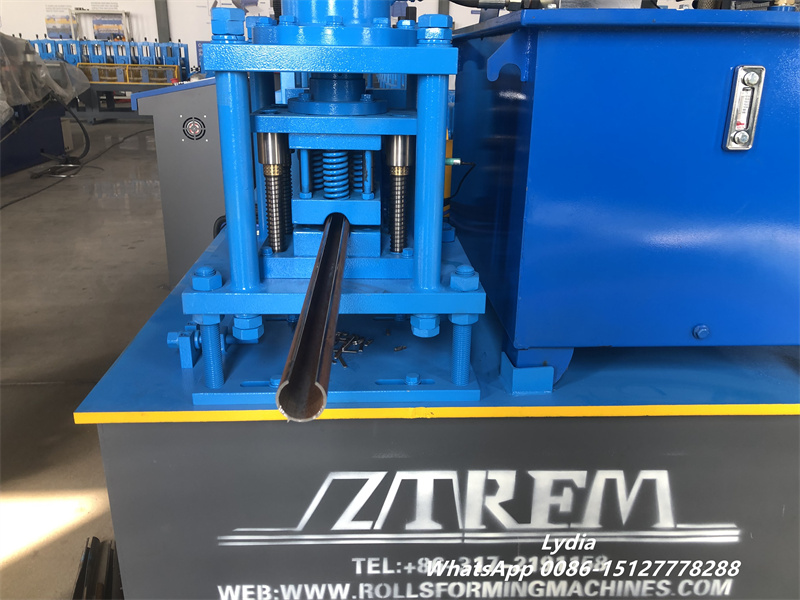
The machine uses a high-rigidity frame and gearbox transmission to maintain stable mechanical operation during continuous forming. The main shaft can use heat-treated 45# forged steel, while the forming rollers can use Cr12 or GCr15 according to the required configuration. These components help the machine withstand repeated forming loads and support long-term industrial production.
At the same time, the Delta PLC control system coordinates the production process. Operators can set parameters such as production speed and cutting length through the control interface, while the system monitors machine operation and provides fault alarms. This arrangement reduces unnecessary manual intervention and makes daily operation easier.
The continuous production method also improves material utilization. Because the machine forms the steel strip directly and performs cutting after forming, manufacturers can reduce intermediate handling and unnecessary material waste compared with more fragmented production methods.
The standard forming speed reaches 0–20 m/min, while actual output depends on the anchor rod dimensions, material thickness, cutting length, welding requirements, and downstream processing. For higher-output projects, manufacturers can discuss customized production-line configurations, including multi-line arrangements.
In addition, the hydraulic system supplies power for operations such as cutting and notching. The integrated receiving table then collects the finished anchor rods after cutting, creating a cleaner material flow from raw coil to finished product.
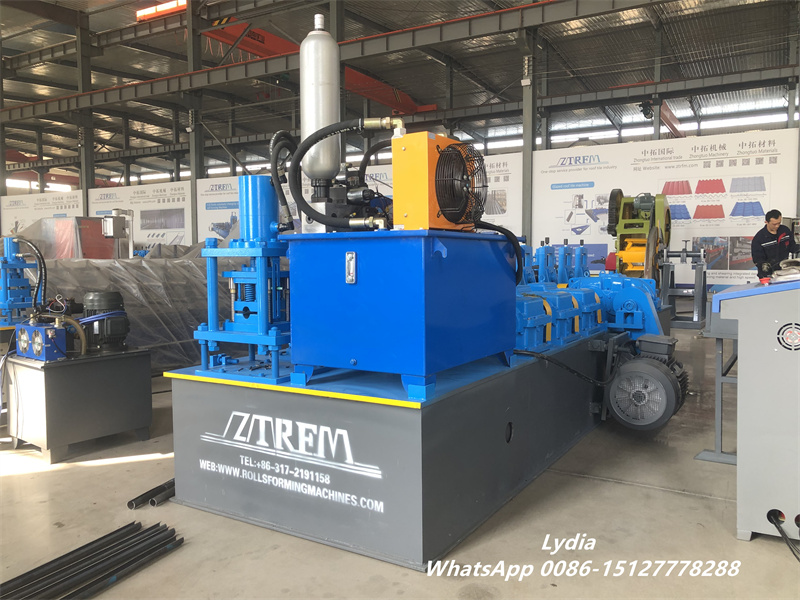
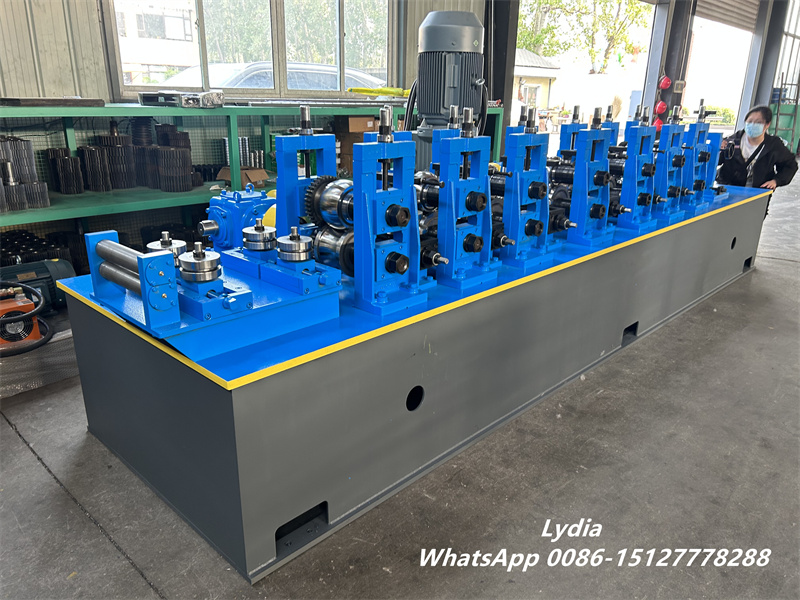
For mining-support and tunnel-engineering manufacturers, production consistency matters as much as forming speed. The Friction Rock Bolt Roll Forming Machine provides continuous forming, welding, straightening, and cutting in one coordinated production process. This configuration reduces the number of independent production stages and helps manufacturers achieve more consistent finished products.
The machine also offers flexibility for different project requirements. Manufacturers can select the appropriate anchor rod profile, material thickness, cutting length, decoiling method, and downstream equipment according to their production plan. Optional end shrinking and thread-processing equipment can further extend the production line for applications that require additional anchor rod preparation.
Overall, the Fully Automatic Anchor Rod Roll Forming Machine provides a practical solution for producing anchor rods and friction rock bolt products for coal mines, metal mines, railway tunnels, highway tunnels, and other underground construction projects. By combining precision roll forming, seam welding, hydraulic cutting, PLC automation, and optional end processing, the machine helps manufacturers build a more efficient and consistent anchor rod production system.
The standard machine is designed for steel strip with a thickness of 2.4–3.2 mm. The exact material grade and mechanical properties should be confirmed according to the required anchor rod profile and application.
The standard forming speed is 0–20 m/min. Actual production speed depends on the material thickness, anchor rod dimensions, welding requirements, cutting length, and overall production configuration.
Yes, the machine can be configured for suitable Split Set / friction rock bolt profiles. However, the final roller design, welding configuration, and downstream equipment should match the customer’s specific profile drawing and product requirements.
Yes. The standard configuration uses a 5.5 kW hydraulic station to power the hydraulic stop-shearing and notching process. The machine can cut anchor rods to the required length during production.
Yes. An optional end-shrinking machine can reduce the rod diameter at the end for subsequent threading and installation of trays and nuts. Thread-rolling and other downstream equipment can also be considered according to the final product requirements.


Full Automatic Metal Rolling Shutter Machine Shutter Door Making Machine
$18,000.00

Automatic Ag Panel PBR Panel or R Panel Roll Forming Machine for
$16,500.00

Double Layer IBR Roof Sheet & Corrugated Sheet Roll Forming Machine
$27,000.00

Anti-corrosion Insulation Board
$4.00

Full Automatic Colored Steel Glazed Tile Forming Machine Glazed Roofing
$16,500.00


